


We’ve built our own custom PIM at Universal Yums, and it’s quite nice.
A PIM (Product Information Management) is the central source of truth for product data. Typically it’s used to manage data across multiple sales channels, allowing companies to easily update product listings across platforms like WooCommerce, Amazon and Etsy all at once.
At Universal Yums, we had a few additional goals. Our product data was scattered across Airtable, Google Sheets, Fulfil (our ERP) and WooCommerce (our ecommerce platform). Aligning that data into one system, with two deploy targets (Fulfil and WooCommerce), was important.
Even more important was ensuring our data was consistent, accurate and complete. The PIM shows every field required for a specific product launch, along with the field owner and deadline, and enforces a standardized format.
Off the Shelf vs Build Your Own
There are a number of off-the-shelf PIM systems we evaluated before building our own- Plytix, Akeneo, Pimcore. One big issue is that none of them integrated with Fulfil directly, so we knew we’d have to build some level of code integration regardless.
The second piece was the level of customization. Building our own software guaranteed we could have the exact interface, deployment system, and granular permissions we needed.
In the age of AI, the real work is defining the best business process and the requirements for implementing it. We felt we’d get a much better and more efficient workflow in the long run by being able to perfectly customize and tune our application.
The Software Stack
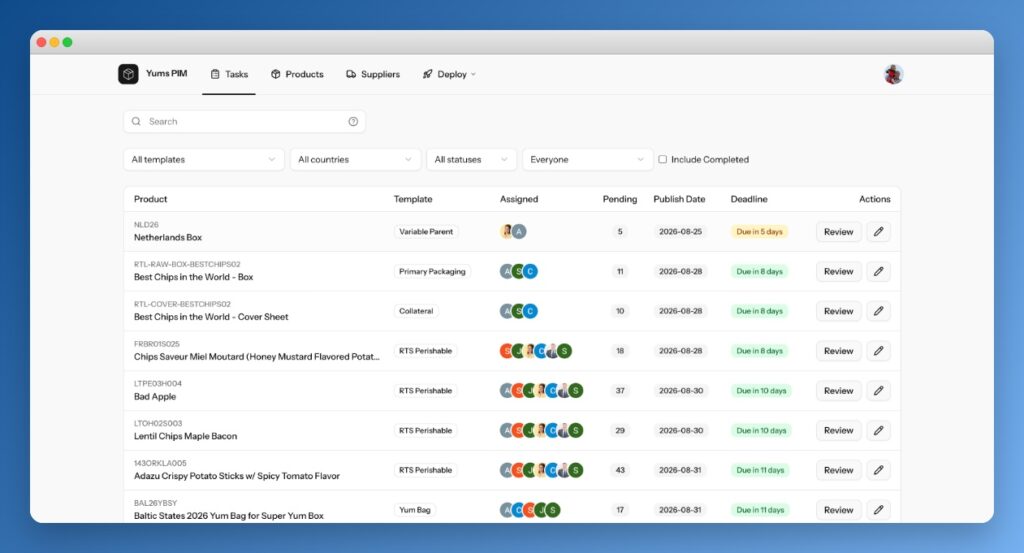
We built the PIM on Laravel, which is a really nice stack for this type of application. There’s well tested packages like Socialite (for Google Workspace authentication), and Spatie (for roles and permissions), and Horizon for queues. Building the frontend with Shadcn + Inertia was a dream- just like plugging legos together.
I am also really happy with the MCP server. Laravel ships an official laravel/mcp package, and we’ve exposed nearly the entire application through it — about 30 tools covering products, suppliers, BOM, field confirmations, deployments, and the task dashboard. That means the whole PIM can be driven by an LLM. An agent connected to it can search products, update fields, confirm tasks, preview a deploy, and ship to production — the same audit log records the change whether it came from the web UI or an AI. Tokens are scoped with capability-based abilities (read, write, deploy), so we can hand an agent exactly the access it needs.
This was the first big greenfield application I built entirely with AI (Claude Code as the driver), without opening the editor once. Knowledge of engineering principles and the Laravel ecosystem was still very useful, but in this new age, being able to clearly describe the business logic and outcomes you want is what’s critical.
As AI makes it much faster to build these types of internal tools, the cost of building them goes down. Our small engineering team is now in the midst of building three other applications like this to help business operations run even more smoothly. If you’re interested in building applications like this, let me know as we may be hiring in the future!

Leave a Reply